


Drones World Editor Kartikeya in conversation with Frank Negretti – CEO ,Cucuyo GmbH
Laser communication has been discussed for years but adoption has remained limited. What has fundamentally changed now that makes Cucuyo confident this technology is ready for real-world UAV deployment?
Because the problem has finally caught up with the solution. UAVs today generate massive amounts of data, while RF is congested, regulated, and vulnerable. At the same time, laser technology has reached the point where it can be miniaturized, cost-optimized, and deployed on airborne platforms. What used to be experimental is now operational. The strongest proof point is that customers have already ordered the first 26 terminals before final full qualification, specifically to test and deploy the system in real applications. That is usually the moment when a technology moves from “interesting” to “needed.
Your partnership with Elbit Systems signals a clear move into defense-grade applications. How do you balance scaling a cutting-edge startup while meeting the stringent reliability and security expectations of military systems?
The key is to separate technology ambition from execution discipline. We focus on one core capability: highly secure, compact laser communication for airborne use. With Elbit Systems we add the know-how for defense applications. Security and reliability expectations in defense are high, but still comparable to any airborne standard.
From a product philosophy perspective, we start with a modular, commercially rooted architecture built on standard components and a fully owned design. The roadmap explicitly includes a military variant alongside the civil terminal and ground station, rather than forcing one product to serve all missions equally well from day one.
Traditional RF communication still dominates the UAV ecosystem. What are the biggest limitations of RF today, and where do you believe it will become obsolete in the face of laser-based systems?
Three things: bandwidth, spectrum, and vulnerability. RF can’t keep up with growing data needs, it’s increasingly congested and regulated, and it’s easy to jam or detect. It’s not going away, but for high-performance missions, it’s reaching its limits.
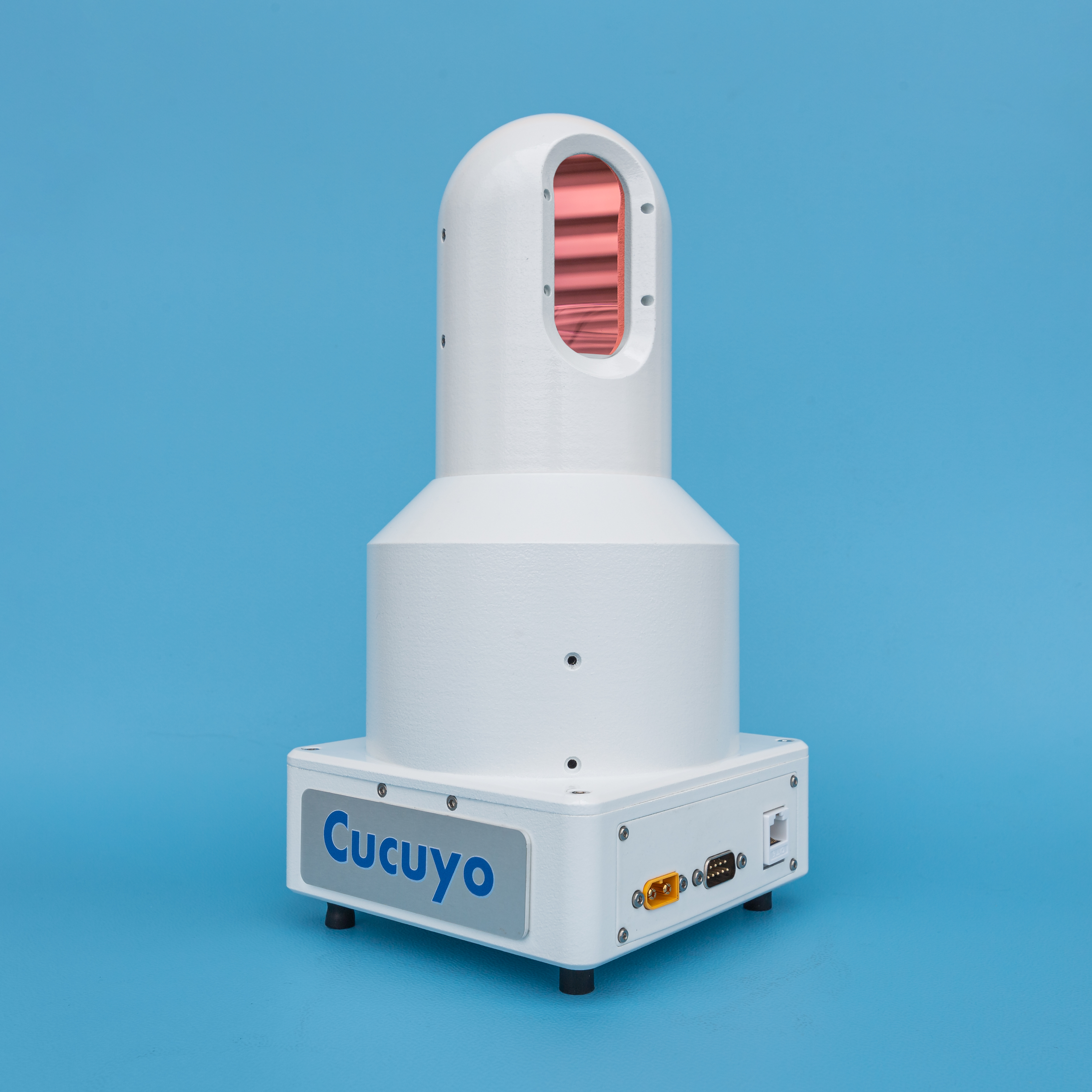
You claim significantly higher data rates and resistance to jamming and interception. In a contested environment, how decisive are these advantages, and could they redefine how unmanned missions are executed?
They can be mission-critical. In a contested environment, communications are not just a support function; they determine whether the asset can deliver value at all. Laser communication enables high data rates while being extremely hard to detect, jam or intercept. That means more reliable links, better real-time intelligence, and lower detectability. In some scenarios, that directly determines whether a mission succeeds or fails.
Miniaturization has always been a barrier for advanced communication systems on UAVs. What were the toughest engineering trade-offs your team had to make to bring laser communication into a compact, UAV-compatible format?
The hardest challenge is always balancing performance against SWaP: size, weight, and power. With airborne laser communication, every gain in pointing accuracy, range, or robustness tends to add mechanical, optical, thermal, or electronic complexity.
Miniaturization without compromising performance, tailored to the application. You need extreme precision in pointing and optics, but within strict size, weight, and power limits. Balancing those constraints — especially for airborne systems — is one of the toughest engineering challenges in this field.
Looking ahead, do you see laser communication becoming a standard across UAV platforms, or will it remain a niche solution for high-end defense and specialized applications?
It will start in high-end missions, but it won’t stay niche — because the real shift is toward platforms, not standalone hardware.
We’re not building a single communication device; we’re building a laser communication platform that can scale across different UAV classes, use cases, and networks. As more drones operate in connected fleets, the need isn’t just for better links — it’s for a standardized, high-performance communication layer.
Laser communication becomes that layer: secure, high-bandwidth, and interoperable. Over time, it integrates into broader systems — combining terminals, ground stations, and network services — and that’s what drives adoption beyond niche applications.
So the long-term vision isn’t a product replacing RF. It’s a platform becoming part of the default communication stack for next-generation UAV ecosystems.
