

Paul & Rren of Drone Kids Academy in conversation with Drones World Editor Kartikeya
AR/VR, and AI are often discussed as future technologies. What has changed now that makes you confident these solutions are ready for real-world drone operations today?
PAUL: What’s changed is convergence. A few years ago, AR, VR, and AI were powerful but fragmented—great in demos, not reliable in the field. Today, we have edge computing capable of processing AI in real time, lightweight AR wearables that can operate outdoors, and highly accurate spatial data pipelines.
In drone operations specifically, latency, reliability, and context-awareness were the missing pieces. Now, AI models can interpret live video feeds instantly, AR can overlay actionable data without distracting the operator, and connectivity is stable enough to support continuous operations.
So it’s no longer about experimenting, it’s about deployment. The technology stack has matured to the point where it can reduce cognitive load, not add to it, which is the real threshold for operational readiness.
RREN: It was often discussed as future technology, but this is no longer the case. A minor example, there are almost 450 XR games available on the PS5, and over 2 billion active AR users on the mobile app stores. This is not a market that will shrink, has hardware and industry is evolving to service this market.
The UAV and Aviation industry is and will continue to be on the cutting edge of technology. We’re simply bringing those tools to the beginning of someone’s education and career path.
Drone Kids Academy sits at the intersection of education and enterprise technology. How do you balance building a scalable training ecosystem while simultaneously developing industry-grade operational tools?
PAUL: We don’t see them as separate tracks; they reinforce each other.
Our training ecosystem is designed around real operational workflows, not theoretical instruction. That means every tool we build for enterprise use feeds directly into how we train pilots. At the same time, the data and behavior we observe from students at scale help us refine our technology.
The balance comes from building modularly. Education is our distribution layer—it scales talent. Technology is our capability layer—it scales performance. When those two evolve together, you create a system where trained operators are already fluent in the tools the industry needs.
Having the experience from the hiring side of things, finding pilots who are certified and trained was a bottleneck. Both education and career path for all verticals is a must. With any education, real world experience and help getting your footing after passing the test is what everyone needs.
Your partnership with Vuzix brings AR directly into live drone operations. In practical terms, how does this shift decision-making for operators working in high-risk and time-critical environments?
PAUL: Traditionally, operators are heads-down—looking at controllers, tablets, switching between screens. That creates friction and delays in decision-making.
With AR through Vuzix, we move to a heads-up environment. Critical data—telemetry, hazard alerts, AI insights—appears in the operator’s field of view in real time.
The practical shift is speed and clarity. Instead of interpreting multiple data sources, the operator receives contextualized information at the exact moment it’s needed. That reduces reaction time, minimizes errors, and allows operators to maintain full situational awareness of both the airspace and the physical environment.
In high-risk scenarios, seconds matter—and AR removes the gap between seeing and deciding.
RREN: Seamlessly. Our integration of real time awareness and collision avoidance via Lyndsey™ is to make it as easy as looking at traffic while you’re driving. Most of the time there will not be any air traffic that you need to worry about and so our overlay will be quiet data you are processing while performing your flight. When you need it, the alerts will notify you of potential risks in a blink of an eye allowing you to safely control your next move. Awareness is key.
Situational awareness and airspace conflict management remain major challenges in modern aviation. How does your Co-Pilot (Lyndsey)™ system aim to solve these issues differently from existing solutions?
PAUL: Most existing systems are reactive—they alert you after a potential conflict has already developed.
Our Co-Pilot™ system is designed to be predictive and assistive. It continuously fuses data from the drone, surrounding airspace, and mission parameters, using AI to anticipate conflicts before they become critical.
But more importantly, it doesn’t just alert—it guides. It can recommend optimal flight path adjustments, prioritize threats, and present that information in a way that’s immediately actionable through AR.
We’re essentially shifting from “pilot monitoring systems” to “pilot augmentation systems.” The goal is not just awareness, but intelligent support that actively reduces risk.
RREN: Lyndsey™ is designed to be agentic in a personal assistant way, creating your flight check lists, flight logs and documentation for training, but also in an AI deep learning capability. Our AR overlay tracks anything commercial or private that has a transponder in real time. A single UAV pilot can have more information literally in their field of vision than previously available.
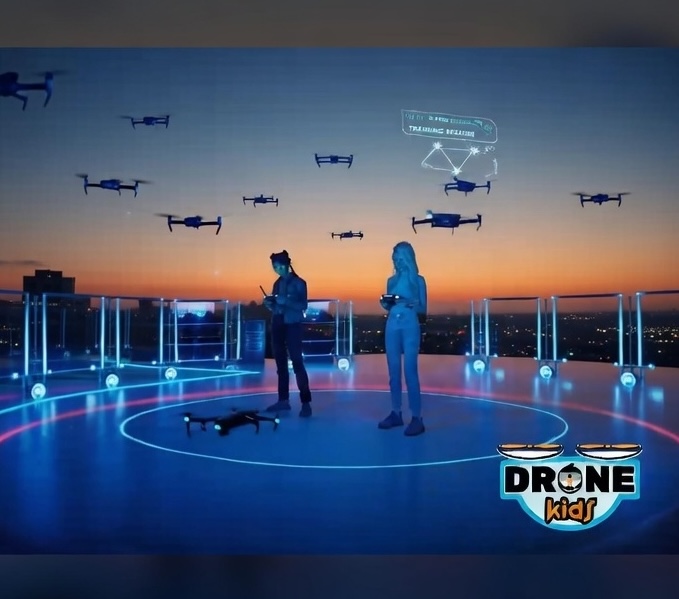
As drone operations expand into public safety and defense-adjacent environments, how critical are real-time data, AI-driven insights, and hands-free interfaces in ensuring mission success?
PAUL: They’re not optional, they’re foundational.
In public safety or defense-adjacent missions, operators are working in dynamic, unpredictable environments where cognitive overload is a real risk. Real-time data ensures they’re operating on current information, AI helps filter and prioritize that information, and hands-free interfaces allow them to act without breaking focus.
When you combine those three, you create a system where operators can move faster, make better decisions, and stay safer.
Ultimately, mission success in these environments comes down to decision velocity and accuracy—and that’s exactly what this stack is designed to optimize.
RREN: It’s cyclical. The future of public safety and defense environments relies on HUMAN input and training for AI. Humans are the ones in control, training our technologies from time-bound inputs and perspectives. AI is trained on datasets we feed it.
Mission accuracy and success comes down to having as much information as possible. Using every tool and data point possible helps insure this.
You are building both a talent pipeline and a technology platform. Which of these do you believe will ultimately drive the most value and scale for Drone Kids Academy?
IPAUL: ndependently, both are valuable. Together, they’re transformative.
Talent without the right tools doesn’t scale. Technology without trained operators doesn’t deploy.
That said, the real long-term value comes from the platform we’re building at the intersection of both. By owning the training pipeline, we’re not just supplying pilots—we’re standardizing how they operate. And by integrating our technology into that process, we create a network effect where every new operator strengthens the ecosystem.
So the answer is: the platform wins. The combination of talent + technology is what creates defensibility and scale.
RREN: We believe the platform as a whole is a tool that will keep our young students supported far into their careers. To me, education is the foundation, but it’s just the start. We’re building a platform that reinforces continuous learning and education through constant support. As a pilot, as with any career, you learn new things all the time. Our platform and technology enables you to house that in one place.
Looking ahead, do you see Drone Kids Academy evolving primarily as an education platform, a technology company, or a fully integrated aviation ecosystem—and what will define success over the next 3–5 years?
PAUL: We’re building a fully integrated aviation ecosystem.
Education is our entry point. Technology is our engine. But the long-term vision is an end-to-end ecosystem where training, certification, operations, and real-time decision support all live within the same platform.
Over the next 3–5 years, success will be defined by three things:
- The number of operators trained and deployed globally
- The adoption of our Co-Pilot™ system in real-world operations
- And measurable improvements in safety, efficiency, and mission outcomes
If we can standardize how drone operations are learned, executed, and supported, then we’re not just participating in the industry—we’re helping define it.
