


Drones World Editor Kartikeya in conversation with Sarah Abdi, Head of Marketing
Parallel Flight recently secured an FAA 44807 exemption. What specific operational limitations were lifted under this approval, and how does it change your commercial deployment strategy in the U.S. market?
Historically, Firefly operated under FAA Certificates of Authorization (COAs), which restricted flights to development and test activities within designated airspace. The recently granted 49 U.S.C. §44807 exemption authorizes commercial operations in the United States.
However, operators are still required to obtain their own 44807 exemption to conduct operations with the aircraft.
This enables broader U.S. operations in applications like heavy sensor integration, remote logistics, and infrastructure support—missions that leverage Firefly’s extended endurance and onboard power.
Strategically, it shifts us from test-based operations to scalable commercial deployment and allows us to convert pipeline into active U.S. revenue.
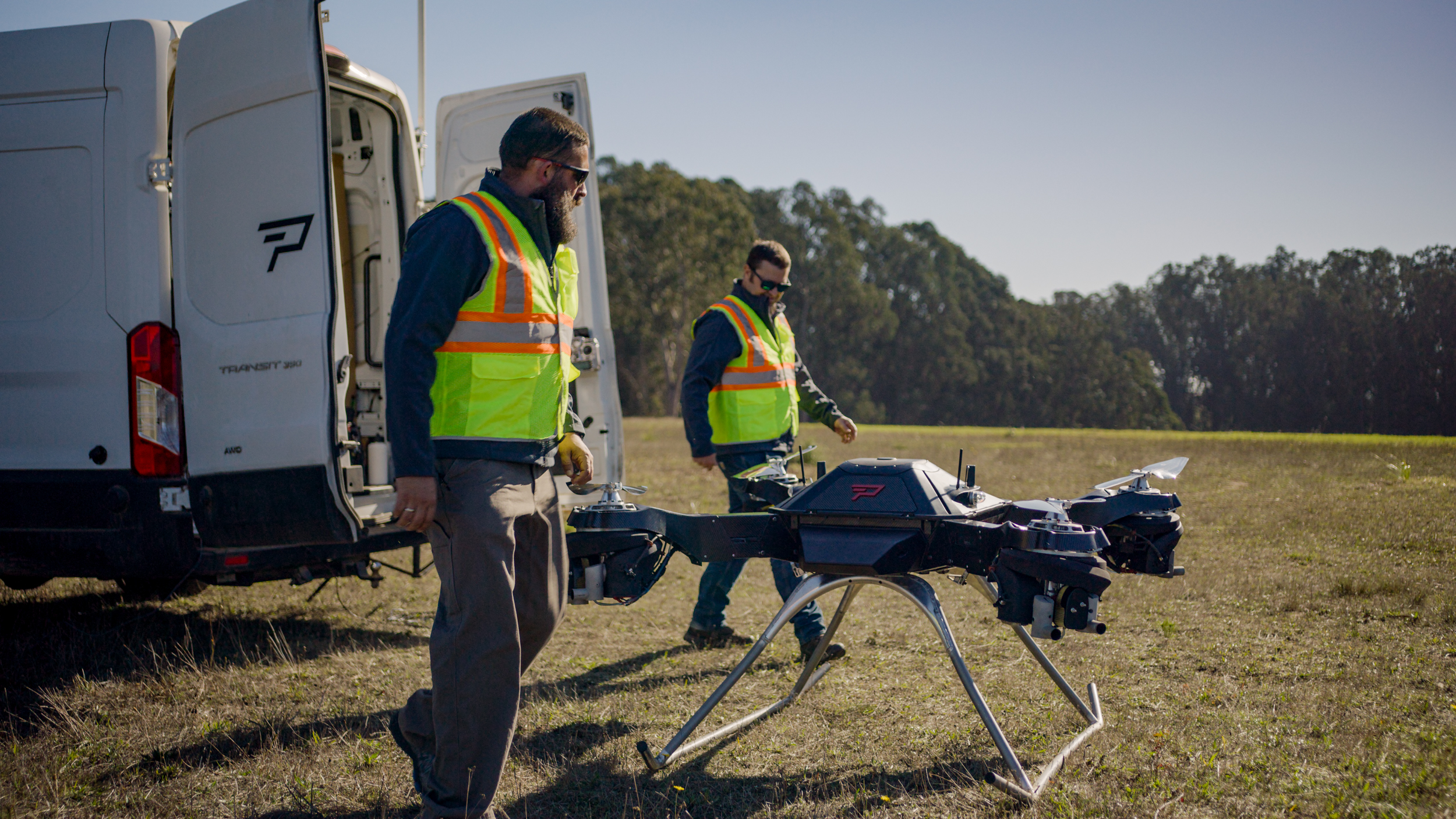
Firefly’s Parallel Hybrid Electric Multirotor (PHEM) propulsion system is a key differentiator. How does hybrid architecture fundamentally outperform all-electric heavy-lift UAS in endurance, payload flexibility, and mission economics?
Gasoline has roughly 14x the delivered specific energy density of today’s batteries, which creates a fundamental endurance advantage. In essence, our energy storage is lighter than a battery option. Our Parallel Hybrid Electric Multirotor (PHEM) architecture captures that energy benefit while preserving the control precision of electric propulsion.
Unlike a serial hybrid, our parallel system distributes hybrid capability at each propulsor—think of it like a Prius at every rotor—allowing us to use combustion, electric, or both simultaneously depending on mission demand. That flexibility is how we achieve up to 10x the range of comparable all-electric heavy-lift UAS.
Beyond endurance, the architecture improves mission economics and reliability. We eliminate charging downtime, reduce cost per mission hour, and maintain full flight capability and redundancy even in the event of an engine failure.
With up to 100 lb payload capacity and extended endurance, which commercial sectors—wildfire response, logistics, utilities, defense—are showing the strongest near-term adoption signals?
Defense is a natural near-term market for us, as it has historically been an early adopter of emerging technologies. We’re also seeing strong signals in heavy sensor integration and geospatial survey work, where operators are often deployed in remote environments and need long endurance without charging infrastructure. Remote logistics is another high-potential sector, especially for missions requiring sustained lift capacity and reduced cost per delivery in austere or infrastructure-limited locations.
Across these sectors, the common thread is operating where endurance, payload, and mission efficiency materially change what’s possible.
Heavy-lift UAS face unique safety and redundancy challenges. How did your safety architecture and reliability testing support the FAA’s confidence in granting the 44807 exemption?
Our proprietary propulsion and control architecture—built around a true parallel hybrid system—was designed from the ground up with fault tolerance in mind.
Each rotor system maintains independent hybrid capability, allowing continued controlled flight even in the event of an engine-related failure. That distributed redundancy is fundamentally different from centralized architectures and materially enhances operational resilience.
In addition, we’ve logged more than 3,400 hours of drivetrain testing, generating the reliability data and operational experience necessary to demonstrate system maturity.
Hybrid systems introduce fuel management, thermal considerations, and mechanical complexity. How have you engineered reliability and maintainability for field operations in remote or austere environments?
We designed Firefly from the outset for modularity and field maintainability. Each propulsion arm is a self-contained module that can be swapped in under five minutes—whether for corrective maintenance or routine servicing. An aircraft-level overhaul can be completed in under 30 minutes using a standard toolkit, without requiring highly specialized technicians.
That modular architecture is what we call rapid maintenance. It minimizes downtime,
simplifies logistics, and supports sustained operations in remote or austere environments.
Operationally, this translates into greater than 96% platform availability. The aircraft can also refuel in under five minutes and return to flight immediately, eliminating charging cycles and enabling continuous mission tempo in the field.
As NDAA-compliant, U.S.-manufactured platforms gain importance, how do you see domestic production shaping procurement decisions across both commercial and DoD customers?
Recent rulings and enforcement actions from the Federal Communications Commission, along with evolving policies within the Department of Defense, are accelerating the shift toward secure, domestically sourced platforms. Supply chain transparency, cybersecurity, and geopolitical resilience have become primary procurement criteria—not secondary considerations. Being U.S.-manufactured positions us strongly as agencies and enterprises actively de-risk their vendor base.
That said, domestic sourcing does introduce cost pressures, particularly prior to achieving large production volumes. Some components remain difficult to source entirely within the U.S., but we’ve developed strong supplier partnerships to close those gaps and progressively strengthen our onshore supply chain.
Looking ahead, do you envision hybrid propulsion becoming the dominant architecture for Group 3 and heavy-lift UAS, or will battery density advances challenge that advantage in the next 3–5 years?
While battery density will undoubtedly improve, there is still an elephant in the room that all electric systems require a HUGE amount of infrastructure. Extra batteries, generators, gas to power the generators, trailers to house all of this equipment, which make solutions like this less than ideal in remote scenarios. 10 gals of gas is equivalent to 880lbs for batteries – in a critical situation for wildfire, defense or disaster relief, it truly is not realistic to lug around 880 lbs of batteries, or a large generator to power even half of those batteries.
