

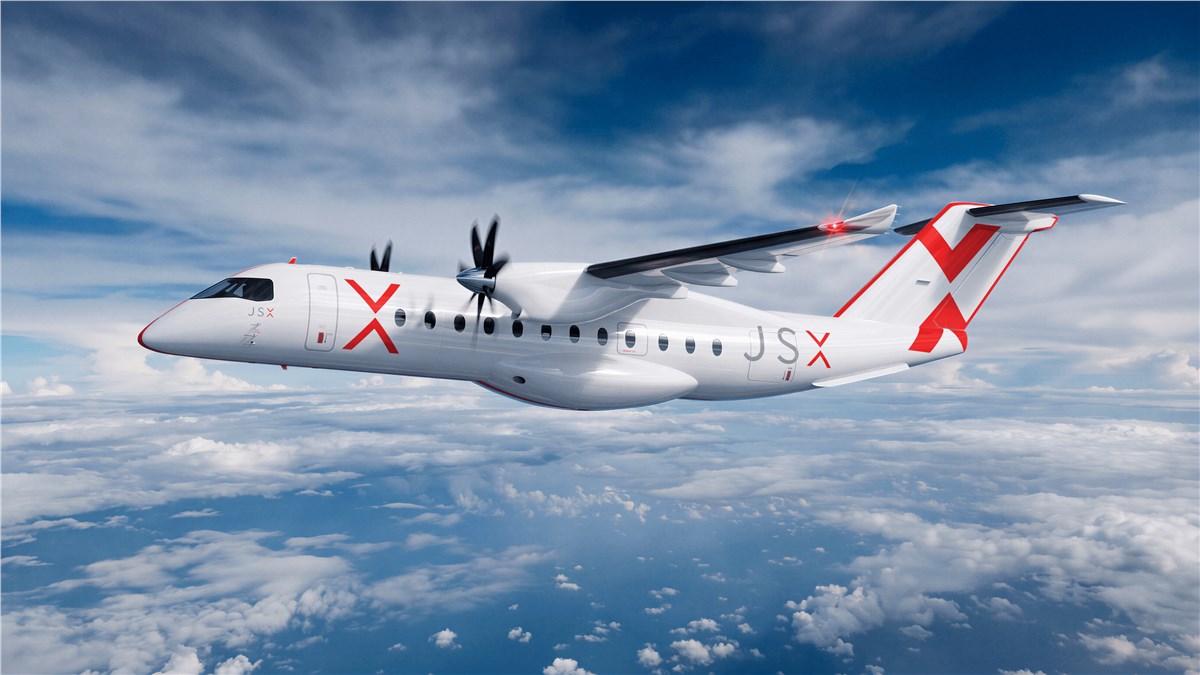
Heart Aerospace has unveiled the ES-36, a 36-seat hybrid-electric regional airliner that the company describes as its production aircraft. Alongside the unveiling, U.S. air carrier JSX announced a deposit-backed purchase agreement for 50 ES-36 aircraft, with purchase rights for an additional 50 aircraft. The agreement builds on the companies’ existing partnership and supports JSX’s plans for a next-generation regional fleet designed to expand nonstop connectivity from convenient community airports.
The ES-36 evolves Heart Aerospace’s previously announced ES-30 with a simplified two-nacelle airframe and series-hybrid electric propulsion architecture. The new configuration is designed to improve operating economics while increasing passenger and payload capacity.
Compared with the ES-30, the ES-36 adds six passenger seats and 1,415 pounds of payload capacity, representing a 20 percent increase in both while retaining the same maximum takeoff weight and battery capacity. The aerodynamic design allows greater capacity for passengers and payload, while reducing the propulsion system from four nacelles and propellers to two, potentially lowering maintenance requirements.
The aircraft uses twin series-hybrid powertrains, with each incorporating a 1.65-megawatt electric motor to drive a propeller. Ground-charged batteries provide an all-electric range of 125 miles (200 kilometres), plus reserves, allowing operators to serve short-haul routes without fuel burn.
For longer missions, the ES-36 is designed to provide a hybrid range of 745 miles (1,200 kilometres), plus reserves. Each powertrain incorporates a megawatt-class turbogenerator powered by a compact gas turbine. The turbogenerators generate electricity during flight to supplement the batteries and power the electric propulsion motors.
Ben Stabler, Chief Technology Officer at Heart Aerospace, said the ES-36 incorporates lessons from the company’s X1 demonstrator programme. He said the production aircraft is designed to carry more passengers and payload while targeting operating costs at least 40 percent lower than legacy regional aircraft.
JSX’s agreement converts its 2023 letter of intent with Heart Aerospace into a deposit-backed purchase commitment and secures early delivery positions. The aircraft is intended to support JSX’s operations at community airports, including Santa Monica, Westchester County, Naples and Napa Valley.
With a 95-foot wingspan, the ES-36 is approximately 11 feet shorter than the ES-30. Heart Aerospace says the compact configuration is designed to support higher-frequency operations and efficient use of airport infrastructure.
The aircraft’s all-electric operations are designed to provide zero emissions during those flights and significantly lower noise. These characteristics could help support operations at community airports where environmental and noise considerations influence aviation activity.
JSX CEO Alex Wilcox said the hybrid-electric ES-36 could enable more nonstop routes from convenient airports while maintaining the airline’s passenger experience. Heart Aerospace and JSX will work together on cabin configuration, charging and turnaround procedures, route planning and airport readiness.
