
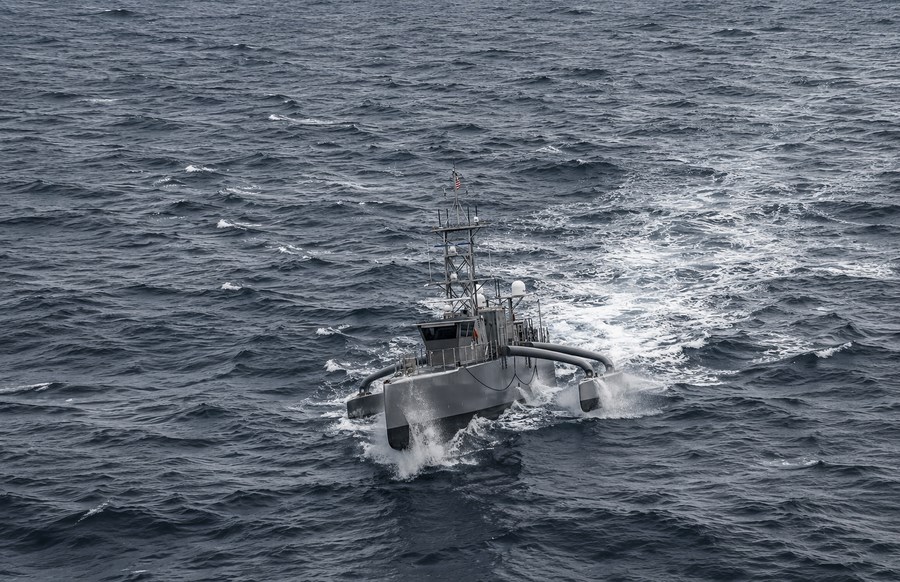
Leidos has reached two significant milestones in maritime autonomy, with its Sea Hunter unmanned surface vessel participating in RIMPAC 2026 and Seahawk operating alongside the USS Theodore Roosevelt Carrier Strike Group. The developments demonstrate the growing use of autonomous vessels in naval operations and the transition of unmanned maritime systems from experimentation toward operational fleet applications.
At RIMPAC 2026, Sea Hunter participated as the exercise’s only Medium Unmanned Surface Vessel (MUSV). Originally developed by Leidos, the vessel is powered by the company’s Leidos Autonomous Vessel Architecture (LAVA), a modular software system supporting autonomous navigation, mission execution and obstacle avoidance.
During the exercise, Sea Hunter operated autonomously over more than 2,000 nautical miles between Pearl Harbor, Hawaii, and San Diego, California. The vessel demonstrated autonomous surveillance and manned-unmanned teaming, operating both as part of a larger naval force and as a standalone platform.
A second milestone involves Seahawk, which is operating with the USS Theodore Roosevelt Carrier Strike Group. According to Leidos, Seahawk is the first MUSV to deploy operationally with a carrier strike group, integrating into the group’s communications, command-and-control and operational framework.
Seahawk’s autonomous capabilities include navigation, perception and collision avoidance. The system is designed to comply with the International Regulations for Preventing Collisions at Sea (COLREGs), while also identifying and avoiding hazards.
The vessel can automatically navigate around designated Keep Out Zones and maintain control through communications failover and remote-control capabilities. Another demonstrated capability is GPS-denied navigation, allowing Seahawk to follow commanded waypoints without GPS before reintegrating GPS while remaining on its planned track.
Both Sea Hunter and Seahawk use LAVA as their autonomy foundation. The modular architecture is designed to support different vessels and mission requirements while providing autonomous navigation, mission execution and obstacle avoidance capabilities.
Leidos says its autonomous maritime portfolio has accumulated more than 200,000 nautical miles of autonomous operation and 14,000 hours of safe autonomous operation, supported by more than a decade of autonomous maritime development and operational experience.
The company’s experience also extends to unmanned systems carrying out more complex missions. In 2021, the Leidos-built MUSV Ranger, operating with LAVA, test-fired an SM-6 Standard Missile from a modular launch system during the U.S. Navy’s Ghost Fleet Overlord programme.
Together, Sea Hunter, Seahawk and Ranger demonstrate how maritime autonomy is being developed across different vessels, missions and operating environments. The latest deployments also highlight the growing emphasis on autonomous navigation, manned-unmanned teaming and resilient operations as naval forces explore new roles for unmanned maritime systems.
