

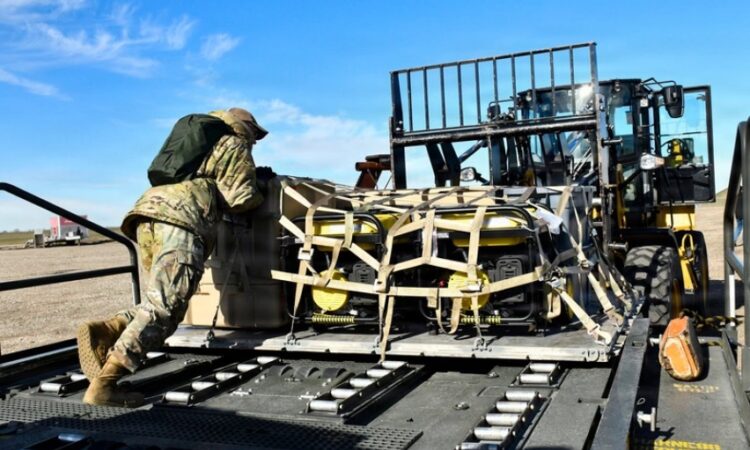
In a recent week-long deployment to Minot Air Force Base, North Dakota, a US Northern Command (USNORTHCOM) team successfully certified as an operational counter-small unmanned aerial system (C-sUAS) unit. The exercise, which took place from October 21-27, saw the team engage over 100 drone targets while providing critical defense support to the 5th Bomb Wing.
The deployment served as the inaugural validation of USNORTHCOM’s new C-sUAS “fly-away kit,” developed by Anduril. This rapid-deployment system is specifically designed to detect, track, identify, and mitigate drone threats to military installations within the United States.
The 11-person team, which had only first trained on the system a month prior during the Falcon Peak 25.2 experiment in Florida, successfully managed the entire operational cycle. This included transporting the equipment via military aircraft from their Colorado Springs headquarters to North Dakota, executing the mission, and redeploying.
“This team far exceeded expectations of operators whose first time seeing the system was 30 days ago,” said Chief Warrant Officer 3 Joey Frey, the command’s C-sUAS response programme manager.
The integrated fly-away kit combines several advanced technologies into a single, cohesive system:
- Heimdal: A mobile sensor trailer with radar, thermal optics, and a 360-degree pan-and-tilt unit for autonomous target acquisition.
- Anvil: Autonomous drone interceptors designed to detect, track, and mitigate threats.
- Pulsar: An electromagnetic warfare effector for radio frequency detection, tracking, and denial.
- The Wisp: An AI-enabled, wide-area infrared system providing a 360-degree sight picture.
Operating in harsh, cold, and wet conditions, the team honed its skills on the system’s command-and-control software, Lattice. Major Austin Fairbairn, the team lead, noted that the exercise provided a “solid foundation of skills” for real-world engagements, despite most members not having a prior C-sUAS background.
Beyond neutralizing drone threats, the team also navigated complex federal statutes and interagency coordination. Their work assisted Minot AFB in updating its drone defense plan to formally integrate the new fly-away kit, ensuring future commanders have the authority and tools needed to protect the base from aerial incursions.
