

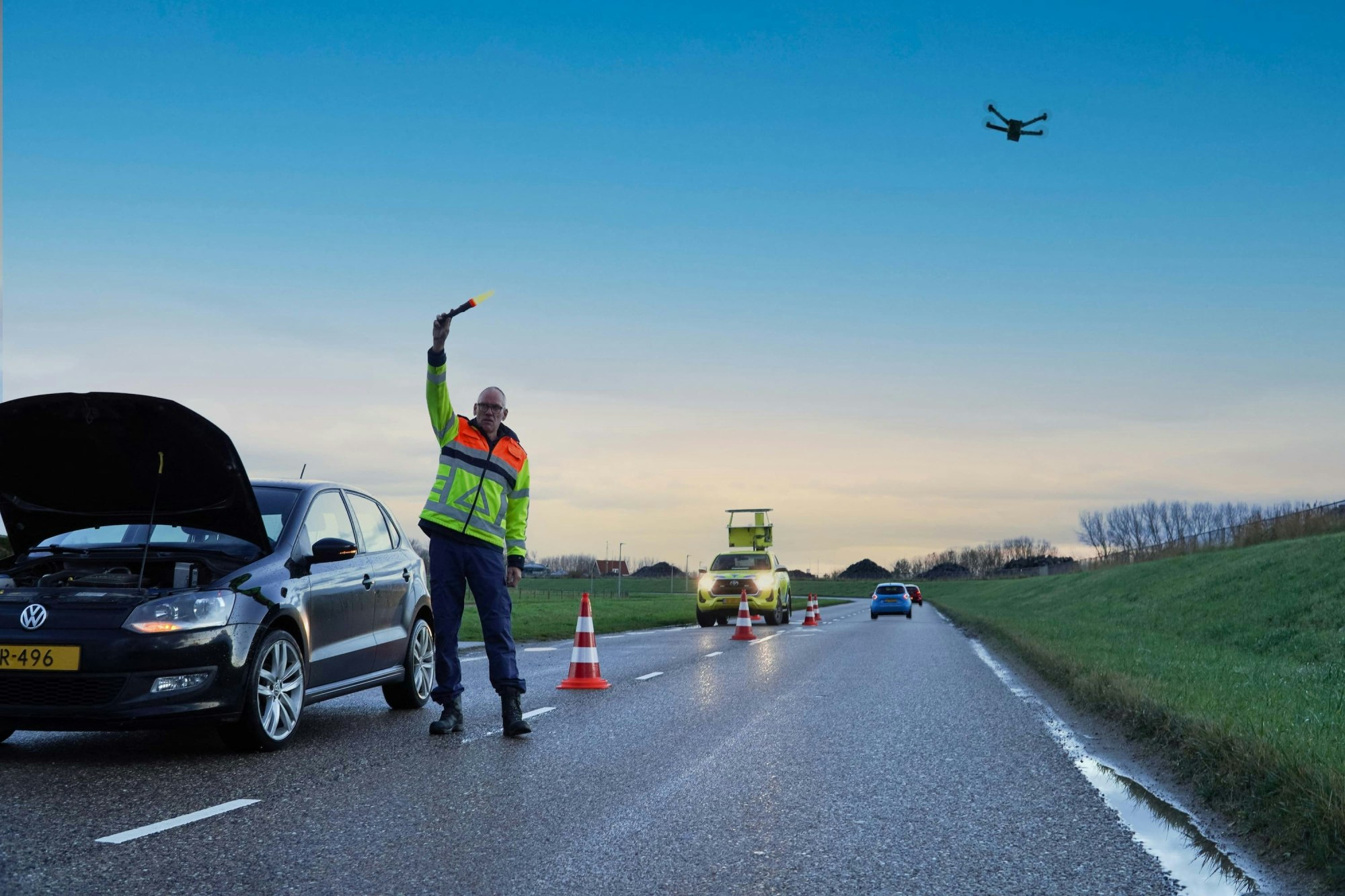
The Netherlands has begun testing beyond visual line of sight (BVLOS) drone operations for emergency and incident response missions as the country prepares new legislation to govern long-distance unmanned flights. These exercises represent proactive steps by Dutch authorities and operators to explore how BVLOS drones can support public services such as firefighting, search and rescue, and disaster assessment once formal regulatory frameworks are established.
Under the trials, authorised drone teams are flying BVLOS missions to simulate real-world response scenarios. Unlike standard visual line of sight flights where pilots must always see their aircraft directly, BVLOS operations allow drones to operate over extended distances without continuous visual contact, enabling rapid deployment to remote or congested areas. Practitioners are using advanced sense-and-avoid systems, satellite navigation and command-and-control links to ensure safety and separation from other airspace users during these flights.
Dutch aviation regulators and emergency services are closely monitoring the outcomes to better understand operational challenges, safety risks and infrastructure requirements associated with BVLOS missions. Lessons from the trials will help shape the government’s forthcoming BVLOS legislation, which is expected to define certification standards, risk mitigation measures and operational procedures for routine beyond visual line of sight flights across differing classes of airspace.
The initiative also reflects coordination with air navigation service providers to assess how BVLOS drones can be integrated alongside manned aircraft safely. Participating teams are evaluating existing airspace management tools and communication protocols to identify gaps and opportunities for improvement ahead of formal rulemaking.
Industry stakeholders have welcomed the tests as a constructive step toward enabling advanced drone capabilities in public service roles. Emergency response organisations in particular see BVLOS flights as a way to improve situational awareness and response times during critical incidents, especially where ground access may be slow or hazardous.
While the Netherlands continues development of regulatory frameworks, the ongoing BVLOS trials demonstrate a forward-looking approach to balancing innovation with safety. By gathering empirical data and refining operational concepts now, authorities are better positioned to implement legislation that supports both aviation safety and effective use of unmanned systems for societal benefit.
