

Drones World Editor Kartikeya in conversation with Pavle Jeremic, CEO and Founder of Aether Biomachines.
Which specific drone performance metrics—like strength, weight, or speed—do your new 3D print polymers directly improve?
Our new 3D print polymers directly improve strength, flexibility, and processability of materials used to produce drone components. Our first commercial product line focuses on super materials for additive manufacturing, using a new class of polymer additives that embed evenly within host materials, similar to how steel rebar reinforces concrete.
Our first two products, RapidPrint and Ultra, enable materials to 3D print up to 10x faster and 2x stronger than current industry benchmarks, and are already being used to power drones for defense as well as complex parts for the aerospace industry.
Some of the materials we’re making right now are among the strongest polymers on the planet, offering aluminum and even aerospace-grade aluminum strength at roughly half the weight, something that is unprecedented in additive manufacturing.
How can your proteins make the drone industry’s supply chain more resilient and domestic?
To truly make the drone industry’s supply chain more resilient and domestic, we need to rethink manufacturing.
Today, most products, including those required for the drone industry, rely on traditional chemical manufacturing. It’s expensive, wasteful, carbon-intensive, and concentrated in massive factories overseas. This setup makes the supply chain vulnerable to supply chain disruptions or geopolitical tensions.
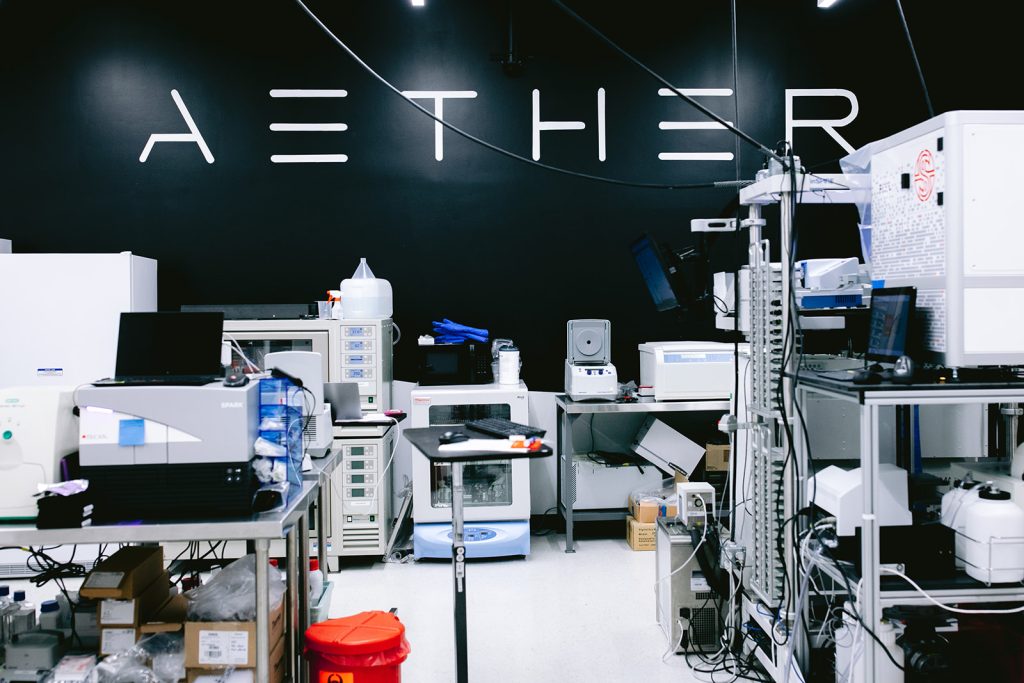
At Aether, we’re taking a different approach. By combining purpose-built AI and high-throughput robotics, we can design proteins that act like molecular assemblers, tiny machines that build, one atom at a time. These nanoscale machines have the precision and sophistication of massive chemical factories, but at a fraction of the size, enabling Aether to make new products faster, more affordably, and more sustainably while moving toward local, on-demand production here in the U.S.
It’s essentially a new model for how things get made, one that makes the U.S. less dependent on foreign suppliers and more in control of its own future of manufacturing.
How does building materials “atom by atom” enable new, previously impossible drone designs?
Aether’s Protein Function Model allows us to design proteins with very specific molecular functions, thanks to the massive proprietary datasets we generate by testing large panels of proteins against different functions in parallel. This means we can specify exactly what we want a protein to do, whether it’s creating a particular molecule, binding to a rare earth, or reinforcing a polymer, and the model outputs a protein capable of executing that function.
By building materials “atom by atom” with these proteins, we gain unprecedented control over the structure and performance of materials at the most fundamental level. For example, Ultra Print can incorporate 40–50% carbon fiber, far beyond conventional limits, producing airframes that are lighter than aluminum but stronger than standard composites. Combined with RapidPrint’s high-speed printing, this allows intricate geometries and drone designs that were previously impossible due to material limitations or manufacturing speed constraints.
Beyond stronger materials, what drone-specific functions (e.g., stealth, self-repair) can your proteins enable?
Today, Aether is already enabling a major leap in strength, speed, and thermal performance through its super materials. These materials are being sold directly into defense and aerospace applications and are already powering drone components.
While we don’t make specific claims around stealth or self-repair today, Aether’s broader platform is designed to unlock entirely new classes of functional proteins. Fundamentally, this is a new way to approach chemistry and manufacturing, which opens up a wide future design space for advanced drone capabilities as the platform continues to scale.
Can your rare earth extraction proteins lower the cost or environmental impact of drone motors and batteries?
Yes, that is exactly the goal of Aether’s rare earth extraction program. Critical minerals are a huge bottleneck in advanced manufacturing, including drone motors and battery systems. Conventional extraction is capital-intensive, environmentally damaging, and highly concentrated outside the U.S.
Aether designs ultra-selective binding proteins that mechanically latch onto specific ions, which are needed for high-temperature, high-stress permanent magnets and release them on command. Think of them as molecular gates that let the wrong atoms flow by.
This creates a faster, cheaper, and more adaptable way to extract rare earths from low-ppm brines or complex ores without building massive new plants. The result is both lower environmental impact and a more resilient, domestic supply of critical materials needed for drone motors and other high-performance components.
How does your rapid protein design shorten the R&D timeline for new drone prototypes?
Aether’s platform uses AI and high-throughput robotics to design proteins at an unprecedented scale and speed. Instead of running slow, sequential experiments, our system can test trillions of protein candidates simultaneously, generating far more data than traditional methods.
For drone R&D, that means new materials or chemical processes can be discovered, optimized, and deployed much faster. A part that might have taken months or years to design using conventional approaches can now be prototyped in days or weeks. Combined with our drop-in super materials for additive manufacturing, this lets flight lines quickly iterate on components, test new geometries, and improve performance without waiting on slow chemical development cycles.
Essentially, we’re collapsing the traditional R&D bottleneck, letting engineers move from idea to functional prototype faster than ever before.
How will this technology create a new, agile industrial base for drone manufacturing in the U.S.?
Aether’s technology makes it possible to re-industrialize the U.S. in a completely new way. Instead of relying on massive factories and global supply chains, AI-designed proteins reduce energy use, waste, and infrastructure requirements. Chemical manufacturing, which traditionally required enormous, centralized plants, can be reduced to a much smaller footprint, even down to the size of shipping containers in the future.
On the materials side, Aether’s drop-in polymer additives run on existing additive manufacturing equipment. That means the current installed base of 3D printers can immediately start producing faster, stronger parts without new hardware. A flight-line facility can pivot from printing one drone component to another in hours, not months.
On the raw materials side, Aether is re-industrializing mineral extraction itself, enabling low-cost, environmentally responsible recovery of critical elements like rare earths within the United States. Together, this creates a more agile, decentralized, and secure industrial base; one that allows the U.S. to produce advanced drones and defense technologies domestically, at scale, without reliance on foreign supply chains.
