
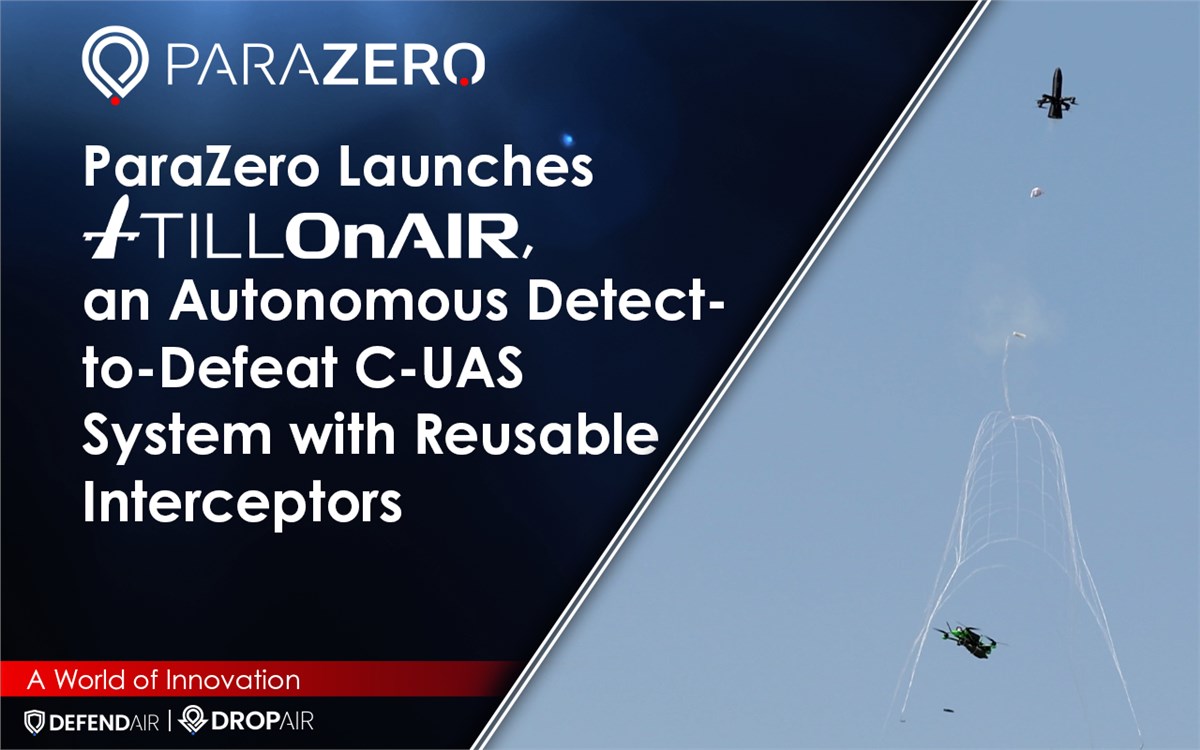
ParaZero Technologies has launched TillOnAIR, an autonomous counter-unmanned aircraft system (C-UAS) designed to detect, track and intercept hostile drones using reusable quadcopter interceptors and a non-explosive net-based mechanism.
Announced on 26 October 2026, TillOnAIR expands ParaZero’s DefendAir product family by combining detection, ground-based guidance and physical interception within a single integrated system. The company says the system is available for purchase and is designed to protect military positions, critical infrastructure and other high-value sites.
TillOnAIR uses a ground-based mission control unit to detect and track incoming drones and guide an interceptor towards the target. Unlike conventional approaches that may rely on onboard navigation or homing equipment, the interceptor does not require onboard GPS, a homing seeker, a camera or a beacon receiver. This architecture is intended to reduce the complexity and cost of the airborne interceptor.
Once deployed, the interceptor approaches the hostile drone and releases a net to capture or disable it. The interceptor is designed to return intact for reuse, with only the DefendAir Net Pod requiring replacement after an engagement. The non-explosive interception method is intended to reduce the risks associated with explosive warheads and falling fragments, particularly around personnel and sensitive infrastructure.
According to ParaZero, TillOnAIR is designed to operate in environments affected by electronic interference. Its physical interception approach does not depend on disrupting the hostile drone’s communications or navigation signals, making it relevant to threats such as fibre-optic-guided, pre-programmed and autonomous drones.
The system offers a configurable 360-degree protection zone with a stated radius of approximately 50–100 metres. Weighing around 15 kilograms and requiring approximately 20 minutes to set up, it is intended for both temporary military deployments and permanent installations. A single ground unit can also coordinate multiple interceptors to address more than one incoming threat.
Potential applications include military outposts, command posts, field hospitals, government buildings, energy facilities, radar stations and air-defence installations. The system may also be suitable for selected security operations and public events where non-explosive interception is desirable.
ParaZero first presented TillOnAIR at the Association of the United States Army (AUSA) Annual Meeting and Exposition in Washington, D.C. The company plans to conduct demonstrations in Israel during November 2026 before pursuing demonstrations in international markets.
The launch reflects growing demand for integrated counter-drone solutions that combine threat detection with an immediate physical response. However, the system’s operational performance and effectiveness will depend on validation under relevant deployment conditions.
